Part Three - Overseas Mails
|
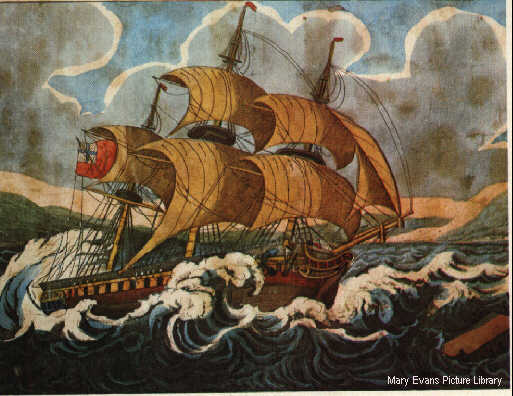
| Early Clipper's were sturdily built but slow. |
The English had been exploring, trading, then colonising since the great explorers of the first Elizabethan age. Sir Walter Raleigh and Sir Francis Drake had opened up great areas of the New World, and this was continued by later discoveries over the next 200 years or so. In fact, by the mid-19th century there was hardly a continent where the British did not have trading facilities, Colonies or settlements - or all three!
Naturally, this meant that there had to be means of corresponding. It was very haphazard and unpredictable. There was no guarantee that a letter would get to its destination at any set time, if at all.
Cargo ships at this time were like this Clipper (see picture at head of the page), sturdily built but slow. They were sailing ships - if there was not enough wind the ship could be becalmed for days. If there was too much wind - or storms - the vessel could be damaged or destroyed, and the mail sunk without trace.
These sailing ships had to take the best route using the prevailing winds and ocean currents. For example great fortunes were made by the merchants and ships Captains who ran the triangular route from England to the Barbary Coast of Africa to pick up slaves, sailed them across the Atlantic to the West Indies, where they sold the slaves and bought rum, sugar, cotton from the plantation owners, and sailed back to England with these cargoes.
Liverpool was the port used mostly for mail coming in from any of these countries, and also for mail from the Colonies in the United States, and Canada. Much of the correspondence was to do with these trades, but of course there were also family letters, telling of the life in the new colonies, explaining what the weather and shops were like.
 |
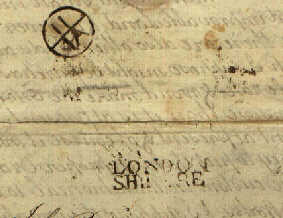
| Letter from New York, 1832, the post mark showing
the first port of arrival in England was Liverpool LIVERPOOL SHIP LRE |
The letter is full of advice to his sisters, about getting to Appalachicola.
'Whether you go to New Orleans first or to New York, you will have to take shipping a second time to reach it,
and the facilities from New York are always as good as from New Orleans, and in respect to vessels, better.
The voyage by way of New Orleans would lead you within the tropics and in view probably of several of the West
India Islands, but your voyage from New York would take you by the Bahamas along the coast of Cuba.'
The letter is crammed with advice as to what clothes, and furniture are essential, and telling them that if they want to bring in musical instruments, they will have to pay a Customs duty on them. The letter arrived in London on the 19th November, less than a month after it was posted.
The England/Australia route took much longer. Looking back on it, from the standpoint of modern steamships, the normal route taken from England to Australia at that time seems unnecessarily roundabout and time consuming. The journey usually took about 8 months, but could take more than 12 months if the weather was unfavourable.
The first settlers with the Fleet which left England in 1787 to colonise New South Wales, sailed south to the Canary Islands, off the coast of West Africa. This took between two and four weeks. Then they sailed diagonally down across the Atlantic ocean to Rio de Janeiro in South America - even with the following winds, and the currents this took about 10 weeks. They stopped to replenish their supplies, and then sailed due East to the Cape of Good Hope, at the foot of Africa. This took another six to eight weeks. Here they stopped again to replenish their food and water for the last long leg across the Indian Ocean to Australia which could take anything from 10 to 12 weeks.
They arrived in January 1788, eight months after leaving England.

As a point of interest this information was produced by Australia Post with a Jig-saw puzzle, which showed one strip of the stamps issued to mark the Bi-Centenary in 1988.
As all the trading vessels made the same kind of journeys, there were always vessels in ports going in different directions. Any ship's Captain would accept mail for other ports en-route to his destination, but for years there was no regular port-to-port mail service. So, if you were waiting for a reply from overseas, you would have literally no idea when it would come in.
A ship carrying passengers to Rio for instance, would stop at the Canary islands. The passengers may have written letters to their families at home, so at Teneriffe, they could make contact with a vessel going back to England, and arrange for the Captain to take their letters. But if there were no ships going back to England the letters would probably be taken on to Rio.
Because of the increasing trade between Britain and the rest of the world, the foreign mail sections of the Post Office expanded - but it was not a monopoly.
If you lived in England and wanted to send a letter to 'foreign parts' you had four options.
1 - You could deliver it to a Post office, and leave it to them ;
2 - You could use a private service - for instance the Bankers of London would forward mail
for their customers - as shown by this example, where the sender asks if they will forward his
letter to Mexico ;

4 - if you lived in London, you could go to any of the Coffee Houses in the main business centre, where the merchants and the ships Captains met to bargain for the transport of cargo. These Coffee Houses had mail sacks for out-going letters, and the ships Captains would take them for a small fee.
From early in the 18th century, the Post Office had its own vessels and also vessels under contract, to carry mail between England and Europe and also Ireland.
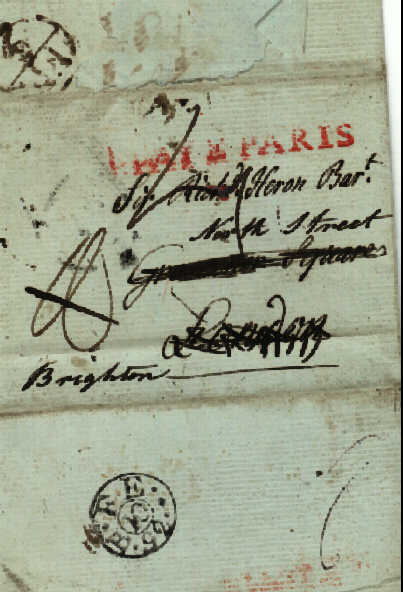 Vessels under Post Office control were called Packet Boats and letters carried on them were called Packet
Letters. The picture to the left is an example of such a letter from France. It was posted in Paris 6th Feb. 1792,
where the French Post Office applied the postmark in red P. PAYE PARIS. This showed that the only postage due from
the person who received the letter would be the cost from the English coast to London.
Vessels under Post Office control were called Packet Boats and letters carried on them were called Packet
Letters. The picture to the left is an example of such a letter from France. It was posted in Paris 6th Feb. 1792,
where the French Post Office applied the postmark in red P. PAYE PARIS. This showed that the only postage due from
the person who received the letter would be the cost from the English coast to London.
It was addressed to Sir Richard Heron, in London but re-directed to Brighton. It arrived in London 3 days after it was posted in Paris - see the London Bishop mark FE 9 - then it would have been transferred to the General Post, for onward transmission to Brighton. The circular datestamp is FE 10, with the year 1792 shown only as 2 figures '92'. The postage due on receipt of the letter was written on in manuscript - 3, crossed out and amended to 4 (1d extra to pay for the re-direction.)
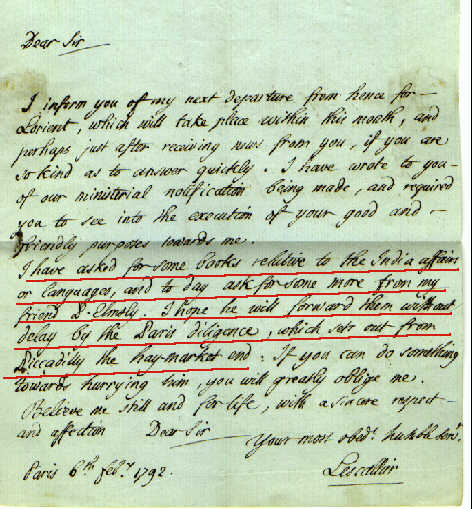
The contents are also interesting, particularly when he says:
'I have asked for some books relative to the India affairs or languages, and today ask for some more from my
friend P. Elmsly. I hope he will forward them without delay by the Paris diligence, which sets out from Piccadilly the hay-market end. If you can do something towards hurrying him, you will greatly oblige me'
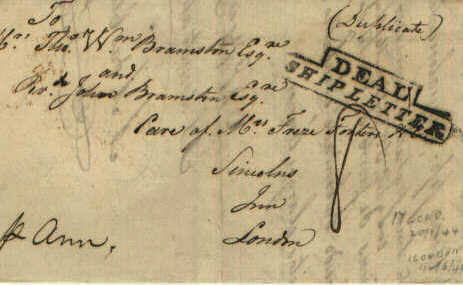
The Ship Letter Act of 1799 gave the Post Office power to use private ships for the conveyance of letters at half the usual Packet rates. As a result mail was despatched on any available vessels - including warships.
A Ship Letter Office was set up at the London Chief Office to deal with the increase in mail and remained there until 1847.
Letters carried on privately owned ships under no agreement for the carriage of mail, were termed Ship Letters. The captains of the vessels carrying them were legally bound to hand in the letters to the Postmaster at their first port of arrival in England. The Postmaster paid them a small sum for their trouble when they handed in the letters.
A number of English ports had their own identifying stamps. As they were locally made, they varied in the shape and content. For example, these two for DEAL, a port on the coast of Kent. The image on the left is from Macao on the private ship 'Ann'. The one on the right is from 1814 on the private ship 'Flame' - Captain Smyth


Others, like this one addressed to John Pringle of Haining Esquire, London, used abbreviations. It was stamped LONDON SHIP LRE and was charged 2d for delivery. It was carried by courtesy of Captain Hutt on the ship 'Camilla'.
An old letter can be fascinating. All the postal markings on the outside of the letter are clues to show the route of the letter and where it stopped on its journey. This letter to India for instance :- it has so many postmarks it is hard to read the address,but it is a letter to Andrew Ross Bell Esq of the British Company of India, Assistant to the Resident, Delhi, via Calcutta.
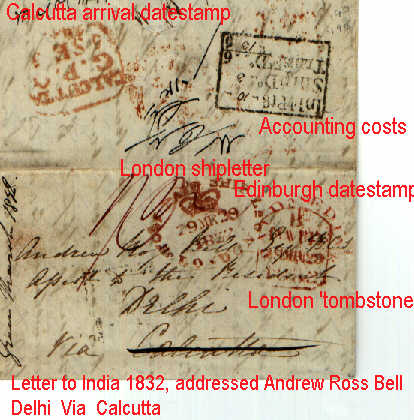
The letter then went on the first available ship to India, where it arrived at Calcutta on 5 Sep, 1832. There, they crossed out Calcutta in the address, and wrote a lot of Indian script letters, to transfer it to Delhi.
The black rectangular stamp on the back is the accounting stamp, and shows how the shipping cost of thirteen shillings and sixpence was calculated. This seems a lot of money to pay to send a letter to your family, which took six months to get there.
However, at this time, there was a lot of mail to and from India, because of the increasing importance of the Indian trade with Britain. In 1815, a service to India and Cape Town was begun and mails were carried by warships, private ships, and those of the the East India Company. But the time taken for the passage was still dependent on the weather.
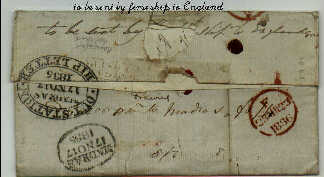
This example shows a letter going the other way. It was posted in Madras 17th November, 1835. The writer endorsed the letter 'to be sent by the first ship to England'. It left the Madras out-station Ship Letter Office on that day, and was received in London 23rd March 1836 - only four months later !
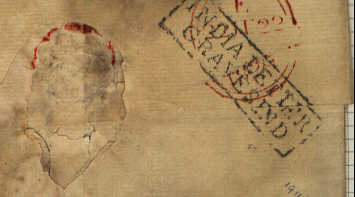
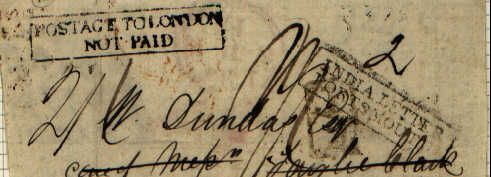
The ships arriving in England docked at different ports, and these two examples show the INDIA LETTER GRAVESEND, and INDIA LETTER PORTSMOUTH stamps
It became obvious that there would have to be a more regular service, and once the steamship had been invented, the Post Office soon began to use them for the mails. The first steamship service to New York began in 1840. This was soon followed by services to India and Australia.
 Part Four, Changes underway Part Four, Changes underway
|
Part 5. Towards Penny Postage